What Is Username Enumeration and How Does It Work?
Username enumeration is the process of systematically discovering where a specific username exists across the internet. It is one of the…
By Ayan Malik · Builder and writer, WhatsMyName App
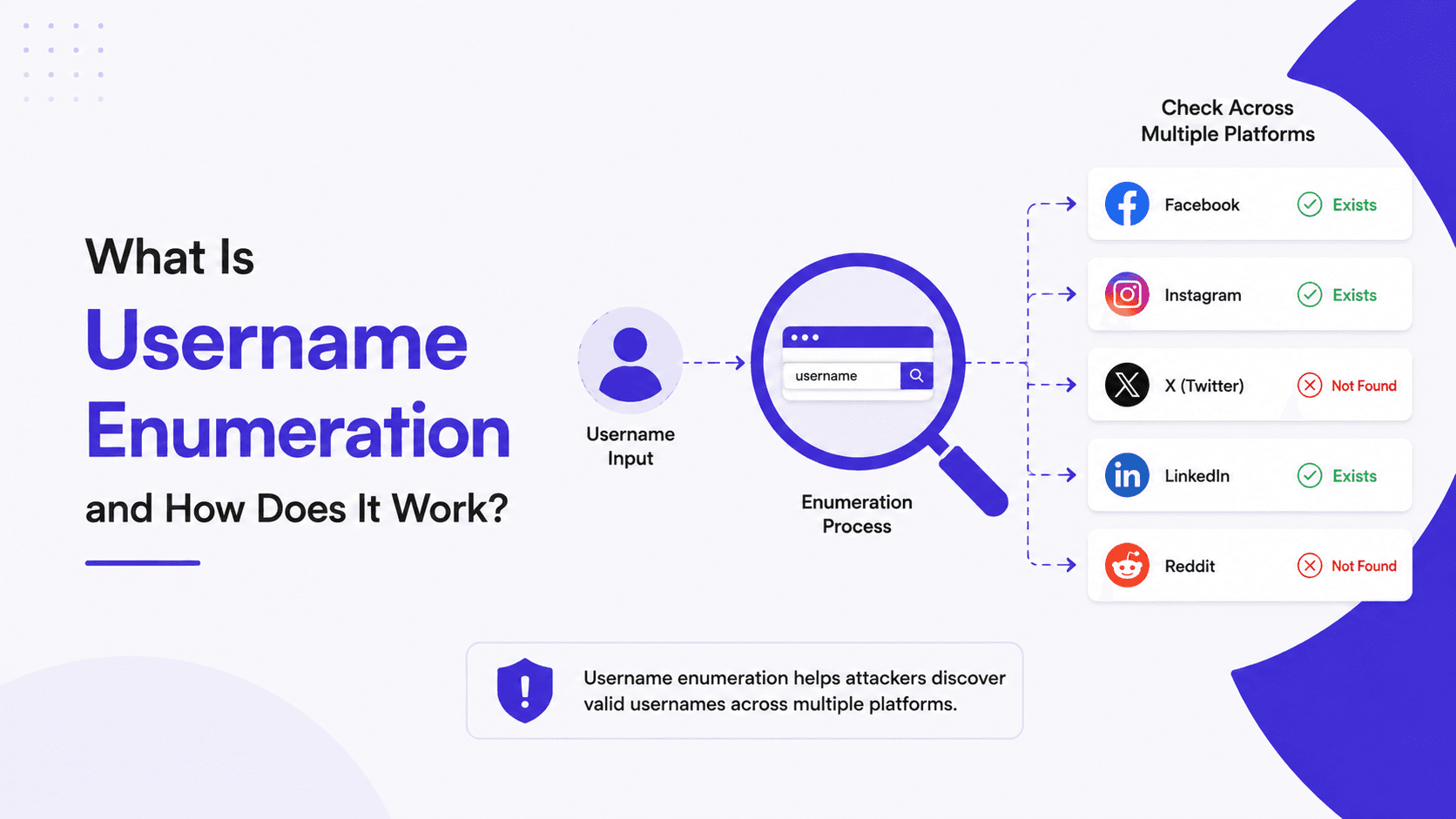
Username enumeration is the process of systematically discovering where a specific username exists across the internet. It is one of the foundational techniques in OSINT (open-source intelligence) investigations and a standard step in digital identity research.
The concept is straightforward. Most people reuse the same username or small variations of it across dozens of platforms. A username created for a gaming forum in 2014 may still be active on that site, and the same person probably used the same handle when signing up for Instagram, Reddit, GitHub, and a dozen other services since then. By enumerating where a username exists, you can map a digital identity across platforms that have no official connection to each other.
This article explains how username enumeration works, why it is effective, what investigators do with the results, and what tools are used to do it in 2026.
The Psychology Behind Why It Works
Username enumeration works because of a consistent human behavior: people reuse usernames.
Inventing a new, unique, memorable username for every service you join is cognitively demanding. Most people settle on one or two handles they like and reuse them everywhere. Some add a number or a period when their preferred handle is already taken on a new platform, but the core string stays the same. johndoe, johndoe1, john.doe, johndoe99 are all variations of the same underlying identity.
This reuse creates a traceable thread. A username used on a tech forum in 2012, a Reddit account from 2015, a gaming profile from 2017, and a Twitter account from 2020 may all belong to the same person, even though the platforms have no connection to each other and share no data. Username enumeration finds all of those threads and presents them together.
The more unique a username is, the stronger the connection between found accounts. A common username like user123 found on 50 platforms tells you almost nothing about a specific person. A distinctive username like crypTrack3r_77 found on 15 platforms is highly likely to belong to one person across all of them.
How Username Enumeration Works Technically
At its core, username enumeration is about HTTP requests and response analysis.
Every platform that allows public profiles has a known URL structure for those profiles. Instagram profiles are at instagram.com/username. GitHub profiles are at github.com/username. Reddit profiles are at reddit.com/user/username. These patterns are consistent and predictable.
A username enumeration tool works by:
- Taking the username you provide
- Constructing the expected profile URL for each platform in its database
- Sending an HTTP request to each URL
- Analyzing the response to determine whether an account exists
The analysis of the response is where the intelligence lives. A platform that returns a 200 OK response when a profile exists and a 404 Not Found response when it does not is easy to enumerate. Most platforms are not that simple. They may return a 200 response for both found and not-found states but with different page content. They may redirect to a login page for missing accounts. They may include a specific string in the HTML that indicates a found account.
Quality enumeration tools maintain a database of detection patterns, a known string or response code that confirms an account exists on each specific platform. When the response matches the detection pattern, the account is found. When it does not, it is not found. When the response is unexpected, the result is an error.
The WhatsMyName project's JSON dataset, which is what WhatsMyName App uses, is one of the most widely used detection datasets for this purpose. Each entry in the dataset specifies the URL pattern, the string that confirms a found account, and the string that confirms a not-found response for each platform. The dataset currently covers 732 platforms and is maintained by an open-source community that keeps detection patterns up to date as platforms change.
OSINT Username Enumeration vs Security Username Enumeration
Username enumeration means different things in different contexts, and it is worth being clear about the distinction.
OSINT username enumeration is what this article primarily covers. It involves checking whether a username exists on public-facing platforms to map a person's digital presence. The platforms being checked are all publicly accessible. No authentication is bypassed. No private data is accessed. This is the kind of enumeration used by investigators, journalists, HR teams, and security researchers investigating digital identities.
Security/penetration testing username enumeration is a different technique used in cybersecurity assessments. It involves discovering valid usernames on a specific system, such as a web application, a corporate network, or an authentication endpoint, by exploiting differences in how the system responds to valid versus invalid credentials. For example, a login form that says "incorrect password" for a valid username but "user does not exist" for an invalid one is leaking information that can be used to enumerate valid accounts. This is a vulnerability, and penetration testers identify it so it can be fixed.
The two techniques are related in concept but entirely different in application. OSINT username enumeration checks publicly accessible public profile pages. Security username enumeration probes authentication systems for information disclosure vulnerabilities.
This article focuses on OSINT username enumeration.
What Investigators Do With Enumeration Results
Running a username enumeration tool returns a list of platforms where the username exists with direct links to each profile. That list is the starting point, not the end point. Here is what investigators actually do with the results.
Verification
The first step after enumeration is manual verification. Click through to each found profile and confirm the account belongs to the person you are investigating. Check the display name, profile photo, bio, and any posted content. The same username can be used by different people on different platforms, especially common handles. Only accounts that can be confirmed as belonging to the same person should be included in investigation findings.
Correlation
Once you have a set of verified profiles, look for information that connects them. Does the bio on the GitHub profile mention the same city as the Twitter profile? Does the Reddit account post about topics consistent with the person's known professional background? Does the gaming profile use the same avatar as the Instagram account? Correlation strengthens confidence that found accounts belong to the same person.
Pivoting
Each verified profile may contain additional identifiers that can be used to expand the investigation. A bio that mentions a real name, an employer, a city, or a linked website. A profile photo that can be used for a reverse image search. An email address visible on a GitHub profile. A linked account on another platform not in the enumeration results. Pivoting means using these new identifiers to run additional searches.
Pattern analysis
People who use variations of a username often follow a predictable pattern. johnsmith, johnsmith1, johnsmith_official, jsmith99. Once you identify the core pattern, you can run additional searches for likely variations to find accounts the person created using a slight modification of their usual handle.
Documentation and reporting
For professional investigators, security researchers, and journalists, found accounts need to be documented systematically. Each profile requires a screenshot, a direct URL, the date of capture, and a note about what information is visible on the profile. This creates an evidence trail that can be referenced in reports, legal proceedings, or journalism.
Username Enumeration Tools Used in 2026
Several tools are actively used for username enumeration in 2026, each suited to different workflows.
WhatsMyName App (web)
The fastest no-setup option. Paste in a username, run the search, and results stream in real time in your browser. Based on the WhatsMyName JSON dataset covering 732 platforms. No install, no account, no command line. Results are clickable with direct profile links and can be exported to CSV.
Best for: Quick lookups, non-technical users, first pass in an investigation.
Maigret
The most powerful enumeration tool available in 2026. Covers 3,100+ platforms, runs recursive searches on newly discovered usernames, parses profile data including bios and linked accounts, and generates professional reports in multiple formats. Requires Python.
Install: pip3 install maigret
Best for: Professional investigations requiring maximum coverage and identity mapping.
Sherlock
A Python command-line tool covering 479 platforms. Supports Tor, proxies, batch processing, and multiple export formats. Well established and widely packaged.
Install: pip3 install sherlock-project
Best for: Terminal users and scripted workflows.
Blackbird
A Python tool that uses the WhatsMyName dataset (732 platforms) with a CLI interface and outputs to JSON and HTML. Good for investigators who want the WhatsMyName dataset coverage in a local command-line format.
Naminter
A newer async Python tool also using the WhatsMyName dataset with TLS-level browser impersonation to bypass Cloudflare and bot detection that stops other tools. Category filtering, PDF and CSV export.
Install: pip install naminter
For a full comparison of these tools, read the comparison of username enumeration tools.
What Username Enumeration Cannot Do
Understanding the limits of the technique is as important as understanding what it can do.
It cannot access private accounts. Username enumeration checks publicly accessible URLs. A private Instagram account, a locked Twitter profile, or any profile behind authentication returns limited information even when the account is detected as found.
It cannot prove identity. Finding the same username on 20 platforms does not prove the accounts all belong to the same person. The same username can be used by different people. Verification and correlation are required to establish identity.
It cannot find accounts that do not follow the expected URL pattern. Some platforms use numeric IDs rather than usernames in their profile URLs. Some allow users to set custom URLs that differ from their username. These accounts may not be detectable by enumeration tools.
It cannot retrieve historical data. Enumeration reflects the current state of each platform. Deleted accounts, changed usernames, and deactivated profiles return not found. The tool cannot tell you what username someone used on a platform in 2019 if they changed it since then.
It cannot search closed or private communities. Discord servers, private Facebook groups, closed forums, and invite-only communities are not accessible through enumeration tools.
Is Username Enumeration Legal?
Yes, in most jurisdictions. OSINT username enumeration checks publicly accessible profile URLs. Looking up whether a username exists on a public platform is equivalent to typing the URL into your browser manually. It does not involve bypassing authentication, accessing private data, or violating any platform's terms of service in a way that creates legal risk for the person running the search.
What you do with the results is a separate legal question. Using enumeration results to stalk, harass, threaten, or harm someone is illegal regardless of the tool used. For a full breakdown of the legal and privacy considerations, read is username search legal.
Frequently Asked Questions
What does username enumeration mean?
Username enumeration is the process of discovering where a specific username exists across multiple platforms on the internet. It works by checking known profile URL patterns on each platform and analyzing the response to determine whether an account exists.
Why do people reuse usernames across platforms?
Most people reuse usernames because it is easier to remember one handle than to create a unique one for every service. This habit creates a traceable thread across platforms that OSINT investigators use to map digital identities.
Is username enumeration the same as hacking?
No. OSINT username enumeration checks publicly accessible profile pages. It does not involve bypassing authentication, accessing restricted data, or exploiting vulnerabilities. Security username enumeration, which probes authentication systems for information disclosure, is a separate technique used in penetration testing with explicit authorization.
What is the best username enumeration tool in 2026?
For quick lookups with no setup, WhatsMyName App is the best starting point. For professional investigations requiring maximum coverage, Maigret is the most powerful option. For scripted workflows, Sherlock integrates cleanly into CLI pipelines. Read the full tool comparison for a detailed breakdown.
How accurate are username enumeration results?
Accuracy depends on the quality of the detection dataset and how recently it has been updated. The WhatsMyName JSON dataset, used by WhatsMyName App and several other tools, is community-maintained with active contributions. False positives occur when a platform changes its response behavior after a detection was written. Always manually verify results that matter to an investigation.
Can someone enumerate my username to find my accounts?
Yes. If your username is publicly visible on any platform, someone can use enumeration tools to find other accounts you have registered under the same or similar username. This is one reason to audit your own digital footprint regularly. Run a search on your own username in WhatsMyName App to see exactly what is publicly connected to your handle.
How is username enumeration used in cybersecurity?
In cybersecurity contexts, username enumeration is used in both offensive and defensive ways. Penetration testers enumerate usernames to identify valid accounts that can be targeted in credential attacks. Defenders look for username enumeration vulnerabilities in their own systems to close the information leakage before attackers can exploit it.
Want to run a username enumeration search right now? Try WhatsMyName App free →
Browse the full OSINT tools directory for more tools used in digital identity investigations.
Written by
Ayan MalikBuilder and writer, WhatsMyName App
Ayan Malik builds and maintains the username search interface on this site, and writes the guides published here on OSINT, username research and digital privacy.
More from Ayan MalikTry the username lookup tool
Search 732+ platforms in seconds, free, no sign-up required.
WhatsMyName AppRelated Posts
 OSINT
OSINTHow to Search a WhatsApp Username (And What Actually Works)
WhatsApp launched usernames in 2026 with no public directory and no search, on purpose. Here is what a WhatsApp handle really tells you, and what works instead.
 OSINT
OSINTFree Digital Footprint Checker: Search 732 Platforms by Username
Check your digital footprint free by username. WhatsMyName App scans 732 platforms and shows every account registered under your handle in under 90 seconds.