WhatsMyName App vs Sherlock vs Maigret vs Namechk: Which One Should You Use?
WhatsMyName App, Sherlock, Maigret, and Namechk compared side by side on coverage, speed, accuracy, and which tool fits which situation.
By Ayan Malik · Builder and writer, WhatsMyName App
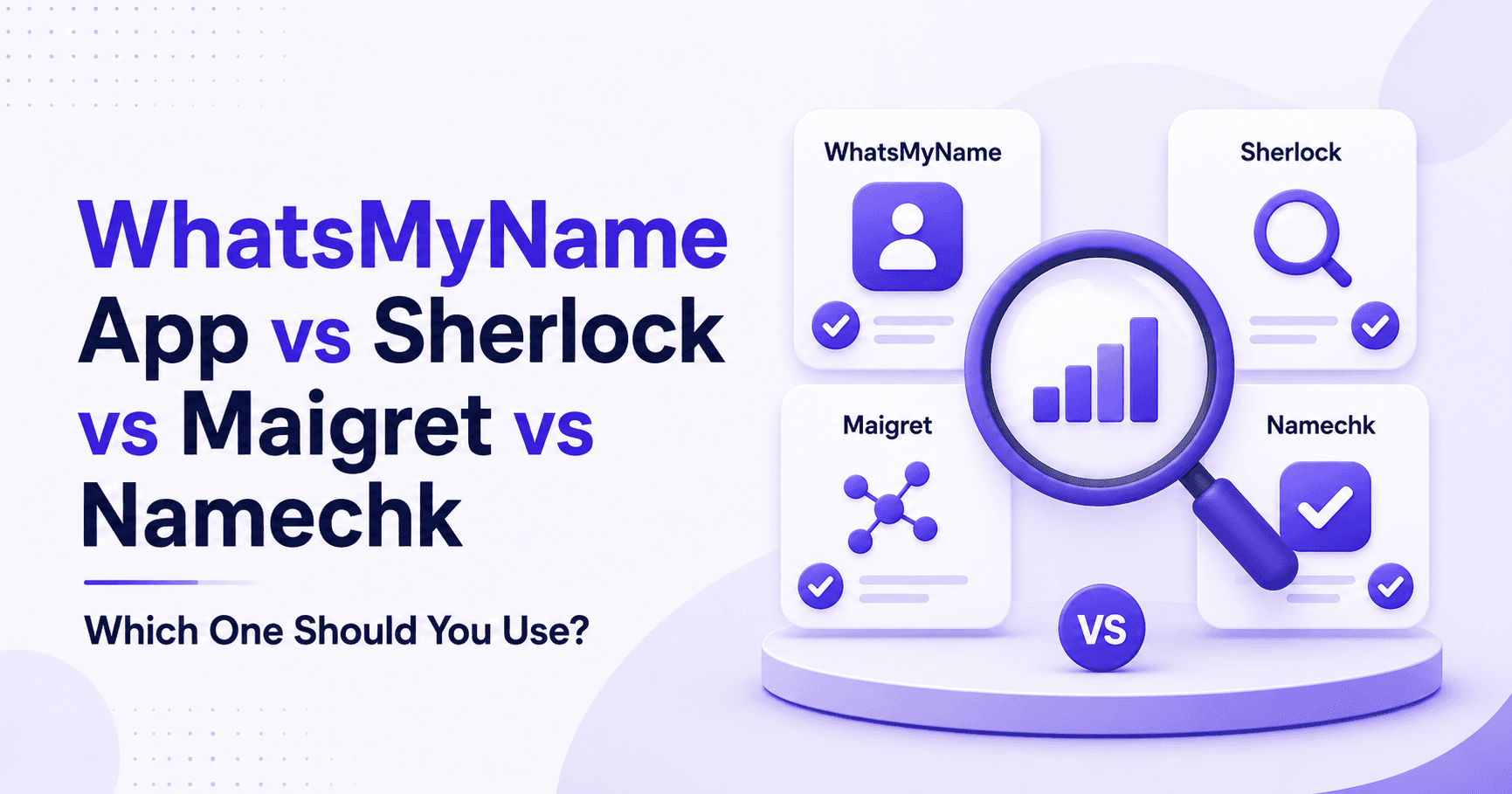
There are four tools most people reach for when they need to search a username across multiple platforms: WhatsMyName App, Sherlock, Maigret, and Namechk. They all do roughly the same thing on the surface. Under the hood they are built for completely different situations.
This comparison covers actual differences in coverage, setup requirements, accuracy, speed, and use cases. By the end you should know exactly which one to use without having to install three tools and test them yourself.
Quick Comparison Table
| Tool | Sites covered | Install needed | Open source | Best for |
|---|---|---|---|---|
| WhatsMyName App | 732+ | No (runs in browser) | Yes | Fast lookups, no setup, any device |
| Sherlock | 479 | Yes (Python CLI) | Yes | Terminal users, batch processing |
| Maigret | 3,100+ | Yes (Python CLI) | Yes | Deep investigations, identity mapping |
| Namechk | ~100 | No (runs in browser) | No | Brand name and handle availability |
WhatsMyName App
WhatsMyName App is a browser-based tool that checks 732+ platforms simultaneously. You enter a username, click Search, and results stream in real time with clickable links to every found profile. No Python, no terminal, no configuration.
The underlying data powering the tool is the WhatsMyName JSON dataset maintained by Micah Hoffman and an open-source community on GitHub. That same dataset is used by several other tools including Blackbird and Maigret, which means the detection quality for sites in the dataset is high. Platforms are community-reviewed and false positives are actively reported and removed.
What it is good at:
- Running a fast, accurate check from any device without setup
- Category filtering so you can focus on social media, gaming, coding, or dating separately
- Exporting results to CSV for reporting or further investigation
- Being the fastest path from a username to a list of live profile links
Where it falls short:
- It does not parse profile data, bios, or linked accounts
- It has fewer sites than Maigret
- It requires a browser, so it does not integrate cleanly into automated CLI pipelines
Sherlock
Sherlock is a Python command-line tool that checks approximately 479 sites. It is the most widely installed username search tool in the OSINT community and is available through pip, Homebrew, Docker, and most Linux package managers.
You run it with a single command: sherlock username. It outputs results to the terminal and can export to CSV, plain text, or XLSX. It supports Tor and proxy configurations for anonymity, and accepts multiple usernames in a single run.
What it is good at:
- Integrating into scripts and automated workflows
- Running on servers without a GUI or browser
- Tor and proxy support for anonymous lookups
- Batch processing multiple usernames at once
Where it falls short:
- Requires Python installed and a working terminal
- Covers fewer sites than WhatsMyName App or Maigret
- No built-in false positive filtering as sophisticated as Maigret
- No web interface, so it is not useful for non-technical users
When to choose Sherlock over WhatsMyName App:
If your workflow involves running searches from a script, a server, or a terminal pipeline, Sherlock integrates better. If you want fast results from a browser with no setup, WhatsMyName App is faster.
Maigret
Maigret is the most powerful tool in this comparison. Version 0.5.0, released in August 2025, brought it to its most capable state. It checks 3,100+ sites, runs recursive searches on newly discovered usernames, parses profile data including bios and linked accounts, and produces reports in HTML, PDF, XMind, and Markdown formats.
The key difference between Maigret and the other tools is the recursive investigation model. When Maigret finds an account on one platform, it can extract links from that profile and automatically search for those linked usernames too. This lets it map a network of connected identities rather than just returning a flat list of found accounts.
Maigret also has per-site check types that actively reduce false positives, and it automatically disables sites known to return unreliable results. The Michael Bazzell IntelTechniques team updated their OSINT virtual machine in April 2026 specifically to accommodate Maigret 0.5.0's new dependency requirements, which reflects how seriously the professional OSINT community takes this release.
What it is good at:
- Maximum site coverage (3,100+)
- Recursive identity mapping across linked profiles
- Professional report generation in multiple formats
- Lowest false positive rate of any tool in this list
- Country and category filtering for targeted searches
Where it falls short:
- Requires Python 3.7 or later and a pip install
- Slower than WhatsMyName App for simple single-username lookups
- Output volume can be overwhelming for quick, casual searches
- Steeper learning curve for non-technical users
When to choose Maigret over WhatsMyName App:
When the investigation is serious. If you need to map a connected identity network, generate an evidence-grade report, or cover as many sites as possible, Maigret is the right tool. For a quick check of where a username appears, WhatsMyName App is faster and easier.
Install Maigret with: pip3 install maigret
Basic usage: maigret username
Namechk
Namechk checks around 100 platforms and is designed for a different use case entirely. It was built to help individuals and brands check whether a username or domain name is available before registering it. It is not an OSINT tool.
It works from a browser with no install, which makes it accessible, but the limited platform coverage and marketing-focused design mean it is not useful for security research or investigations. It does not provide direct links to found profiles in the same way WhatsMyName App does, and it does not distinguish between a confirmed account and an unavailable name as reliably.
When Namechk makes sense:
You are launching a new brand, choosing a username across platforms, or checking handle availability before signing up for multiple services. For that specific use case it is fast and simple.
When to use something else:
Any investigation, any OSINT work, any situation where you need to know if a specific person has an account on a specific platform. Use WhatsMyName App for that.
Side-by-Side: Which Tool for Which Situation
| Situation | Best tool |
|---|---|
| Quick lookup from a phone or tablet | WhatsMyName App |
| No technical background, need results fast | WhatsMyName App |
| Running searches inside a script or automation | Sherlock |
| Deep investigation, identity mapping | Maigret |
| Checking username availability before registering | Namechk |
| Need an evidence-grade investigation report | Maigret |
| Filtering results by category (gaming, social, dating) | WhatsMyName App |
| Need Tor or proxy support | Sherlock or Maigret |
| Maximum platform coverage | Maigret |
A Note on Accuracy
All four tools have false positives to some degree. A false positive is when the tool reports a username as found on a platform, but clicking the link shows no active account.
Maigret has the lowest false positive rate because it actively maintains per-site detection rules and disables sites known to behave unreliably. WhatsMyName App's community-reviewed dataset is also high quality. Sherlock has a moderate false positive rate managed by community maintenance. Namechk has the least sophisticated detection.
For any result that matters to an investigation, verify it manually by clicking through to the live profile before drawing conclusions.
How They Relate to Each Other
These tools are not entirely separate. WhatsMyName App, Sherlock via the Sherlock project, and Maigret all use or draw from open-source username datasets. Maigret actually forked from Sherlock in 2021 and has grown well beyond it. Blackbird, another username checker, also uses the WhatsMyName dataset as its data source.
This means if you are choosing between them, you are mostly choosing between interfaces and features, not completely different underlying data. The WhatsMyName JSON dataset in particular is the most widely used detection substrate in the username search tool ecosystem.
Frequently Asked Questions
Is WhatsMyName App better than Sherlock?
For most users, yes. WhatsMyName App requires no install, covers more sites than Sherlock, and works from any browser on any device. Sherlock is better for users who need terminal integration, proxy support, or automated batch processing.
Does Maigret replace WhatsMyName App?
For professional investigators, Maigret is more powerful. For quick lookups without technical setup, WhatsMyName App is faster and easier. Most serious OSINT practitioners use both depending on the task.
Which tool has the most accurate results?
Maigret has the most sophisticated false positive controls. WhatsMyName App's community dataset is also high quality. Both are more reliable than Namechk for OSINT purposes.
Can I use all four tools together?
Yes, and many investigators do. A common workflow is WhatsMyName App for a quick initial scan, then Maigret for a deep follow-up investigation on usernames of interest.
Is Sherlock still actively maintained?
Yes, as of May 2026 Sherlock is maintained at github.com/sherlock-project/sherlock with regular site additions and bug fixes.
Which tool is best for beginners?
WhatsMyName App. No setup, no technical knowledge required, and results are clear and easy to read. It is the fastest path from a username to useful information for someone new to OSINT.
For the full OSINT tool directory including other username search and investigation tools, visit the OSINT tools directory.
Ready to run a search? Try WhatsMyName App free.
Written by
Ayan MalikBuilder and writer, WhatsMyName App
Ayan Malik builds and maintains the username search interface on this site, and writes the guides published here on OSINT, username research and digital privacy.
More from Ayan MalikTry the username lookup tool
Search 732+ platforms in seconds, free, no sign-up required.
WhatsMyName AppRelated Posts
 OSINT
OSINTHow to Search a WhatsApp Username (And What Actually Works)
WhatsApp launched usernames in 2026 with no public directory and no search, on purpose. Here is what a WhatsApp handle really tells you, and what works instead.
 OSINT
OSINTFree Digital Footprint Checker: Search 732 Platforms by Username
Check your digital footprint free by username. WhatsMyName App scans 732 platforms and shows every account registered under your handle in under 90 seconds.